





- Marine Biodiversity & Ecology: Inventorization and mapping of marine biodiversity hotspots and species assemblage patterns in the Andaman & Nicobar and Lakshadweep Islands.
- Fishery Resources and Habitat Assessment: Assessing fishery resources and habitat suitability for selected meso-pelagic, demersal, and economically important small pelagic fishes in the Indian Exclusive Economic Zone (EEZ).
- Marine Ecosystem Dynamics: Studying marine ecosystem processes in the Arabian Sea and Bay of Bengal, focusing on ocean acidification (OA) and its impacts on biological dynamics.
- Societal Development: Enhancing natural stocks of marine ornamental fishes through hatchery rearing and sea ranching, alongside training coastal and island communities to improve livelihoods.
- Focus: Comprehensively exploring, documenting, and conserving deep-sea fauna within India’s EEZ, particularly around hotspots like seamounts.
- Methods: Developing advanced non-invasive technologies, genomic tools, and capacity-building initiatives to discover novel biomolecules and drugs while ensuring long-term ecological and economic benefits.
- Monsoon Regulation: Investigating northern Indian Ocean interactions and their role in regulating monsoon variability through coupled physical–biogeochemical processes.
- Carbon Cycling & Acidification: Quantifying carbon cycling (including air–sea CO₂ fluxes and carbonate chemistry) and assessing ocean acidification's impact on plankton productivity, calcification, and trophic interactions.
- Trace Gas Emissions: Evaluating the production and emission of climate-relevant trace gases (CO₂, CH₄, N₂O, DMS) and their links to microbial processes, oxygen minimum zones, and ecosystem metabolism.
- Nutrient Dynamics: Assessing productivity responses driven by atmospheric deposition, riverine inputs, and upwelling, including their influence on nutrient stoichiometry and phytoplankton structures.
- Predictive Modelling: Integrating long-term observations, experimental studies (mesocosm/microcosm), and coupled ecosystem–biogeochemical modelling to develop predictive frameworks for future climate scenarios.
Suo Moto disclosure under section 4 of RTI Act, 2005
-
The Right to Information Act 2005 came into force from 12th October 2005 to promote transparency and accountability in the working of every public authority in India. Under the RTI Act, the following information is given on the website of CMLRE: -
1. Organization and Function
1.1 Particulars of its organisation, functions and duties [Section 4(1)(b)(i)]
1.1.1 Name and Address of the organization
Centre for Marine Living Resources and Ecology (CMLRE)
Atal Bhavan, Ministry of Earth Sciences (MoES), Government of India
Ochanthuruthu (PO), LNG Road, Puthuvyppe, Kochi -682508.
1.1.2 Head of organization
Dr. R.S. Maheskumar, Scientist-G & HoD
1.1.3 Vision, mission and key objectives
The CMLRE organizes, coordinates, and promotes ocean research and development in India. Its core mandates include mapping marine resources, preparing inventories of commercially exploitable species, ensuring optimum utilization through ecosystem management, and conducting basic research in Marine Living Resources (MLR) and ecology.
Supported by a Vessel Management Cell (VMC), the Fishery Oceanographic Research Vessel (FORV) Sagar Sampada is fully utilized for these studies. Research focuses on deep-sea fisheries, harmful algal blooms, bioluminescent plankton, marine mammals, productivity patterns, benthos, plankton biodiversity, and nearshore dynamics such as upwelling and mudbanks. It also covers application-oriented R&D and infrastructure development at the Puthuvype campus.
1. The MLR Programme (Under O-SMART / PRITHVI)
Previously restructured during 2017–21 into two projects - MEDAS (Marine Ecosystem Dynamics of eastern Arabian Sea) and REIS (Resource Exploration and Inventorization System)—these activities continue under the PRITHVI scheme (formerly O-SMART). Updated to address climate change and societal needs, the program now features four major themes and objectives:
2. Deep Ocean Mission (DOM)
Launched by the Ministry of Earth Sciences (MoES), DOM is a national program aimed at making India a global leader in deep-sea biodiversity research, fostering sustainable resource use for the Blue Economy, and supporting SDG 14 (Life Below Water) for a Viksit Bharat by 2047.
With only 5% of the deep ocean explored, CMLRE serves as the nodal agency for Theme/Vertical 3: Technological Innovations for Exploration and Conservation of Deep-Sea Biodiversity.
3. Mission Mausam (MM)
The Mission Mausam program advances the scientific understanding of ocean–atmosphere interactions and their influence on marine ecosystems, biogeochemical cycles, and climate variability. It translates these insights into climate-resilient strategies for fisheries and coastal communities through five key objectives:
1.1.4 Function and duties
The Centre for Marine Living Resources and Ecology (CMLRE) implements India's Marine Living Resources (MLR) Programme using the FORV Sagar Sampada to survey, assess, and manage resources within the Indian EEZ. Restructured under the PRITHVI scheme (2021–2026), its activities span four themes: Marine Biodiversity, Fishery Resources/Habitat Assessment, Marine Ecosystem Dynamics (focusing on Ocean Acidification), and Societal Development. Additionally, CMLRE is the nodal agency for Deep Ocean Mission (DOM) Vertical 3, using technological innovations to explore and conserve deep-sea biodiversity at hotspots like seamounts, driving biomolecule discovery for the Blue Economy and SDG 14, and the Mission Mausam program advances the scientific understanding of ocean–atmosphere interactions and their influence on marine ecosystems, biogeochemical cycles, and climate variability. Together, these efforts deliver critical scientific inputs for the sustainable management of marine resources.
1.1.5 Organization Chart
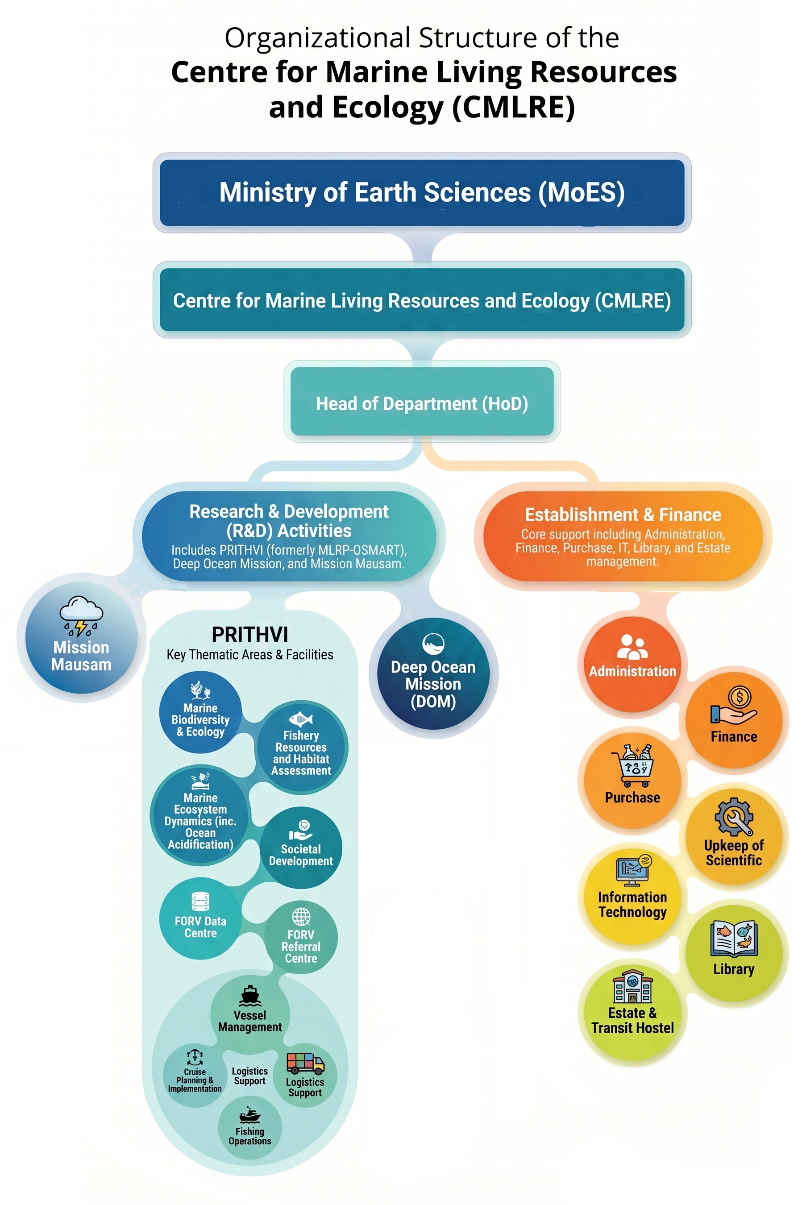
1.1.6 Any other details-the genesis, inception, formation of the department and the HoDs from time to time as well as the committees/ Commissions constituted from time to time have been dealt:
Established at Kochi in 1998 by upgrading the Sagar Sampada Cell, the Centre for Marine Living Resources and Ecology (CMLRE) operates under the Ministry of Earth Sciences, Government of India. It organizes, coordinates, and promotes ocean development activities, including mapping living resources, inventorying commercially exploitable species, ensuring optimum utilization through ecosystem management, and conducting basic R&D in marine living resources and ecology.
The Marine Living Resources (MLR) Programme focuses on the survey, assessment, and exploitation of MLR, alongside studying their response to environmental changes to develop an ecosystem model for managing India’s Exclusive Economic Zone (EEZ). These studies fully utilize the Fishery Oceanographic Research Vessel (FORV) Sagar Sampada. Ongoing surveys target biodiversity, meso-pelagic fisheries and environmental linkages, harmful algal blooms, bioluminescent plankton, marine mammals, and productivity patterns. These are complemented by allied activities, including studies on continental shelf/slope benthos and Andaman Sea plankton biodiversity.
Institutional Structure & Leadership Timeline
CMLRE operates through three major sections:
- Research and developmental activities under MLR Programme (Under O-SMART / PRITHVI), Deep Ocean Mission (DOM) Vertical 3 and Mission Mausam (MM)
- Vessel Management Centre (VMC)
- Establishment and Finance
The center's leadership has driven its growth from coordinating external projects to building robust in-house capabilities:
- Prof. Raveendranathan V. (Inception): Led the center from its beginning, coordinating MLR research across various national institutes and universities.
- Dr. V. N. Sanjeevan (2006–2013): Took charge with a vision to expand CMLRE into a National Centre on MLR in India.
- Dr. Madheswaran (Nov 2013–Sep 2014): Served as Director.
- Dr. M. Sudhakar (Sep 2014–Dec 2019): Established the permanent CMLRE campus at Puthuvype, Kochi, in 2019.
- Dr. M. V. Ramanamurthy (Jan 2020–Oct 2020): Effectively carried forward the journey and strengthened in-house research.
- Dr. G. V. M. Gupta (Oct 2020–May 2025): Served as Head of Department (HoD), significantly strengthening the in-house laboratory facilities for MLR activities.
- Dr. MahesKumar (May 2025–Present): Took charge as HoD on May 28, 2025, and continues to lead the center.
1.2 Power and duties of its officers and employees [ Section 4(1) (b)(ii)]
| Sl. No. | Designation | Name | Power and Duties of Employees |
|---|---|---|---|
| 1 | HoD, Scientist-G | Dr. R.S. Mahes Kumar | Scientist-G and Head of Department |
| 2 | Scientist-G | Dr. GVM Gupta (on loan to NCCR) | |
| 3 | Scientist-F | Shri. N. Saravanane (on loan to NCCR) | |
| 4 | Scientist-F | Smt. C.R Asha Devi | Scientific activities related to MLR |
| 5 | Scientist-F | Dr. Sherine Sonia Cubelio | Scientific activities related to MLR |
| 6 | Scientist-E | Dr. Rasheed Kunjumohammed | Scientific activities related to MLR |
| 7 | Scientist-E | Dr. Anil Kumar Vijayan (on Loan to MoES) | |
| 8 | Scientist-E | Dr. Smitha B R | Scientific activities related to MLR |
| 9 | Scientist-E | Dr. Hashim Manjebrayakath | Scientific activities related to MLR |
| 10 | Scientist-E | Dr. Periasamy Rengaiyan | Scientific activities related to DOM |
| 11 | Scientist-D | Shri.M. Subramanian | Vessel Management Cell & Scientific activities related to MLR |
| 12 | Scientist-D | Shri. C. Vasu | Estate-related matters / Scientific activities related to MLR |
| 13 | Scientist-E | Dr. Kusum Komal Karati | Scientific activities related to MLR |
| 14 | Scientist-E | Dr. Sendhil Kumar | Scientific activities related to MLR |
| 15 | Scientist-D | Dr.Siva Kiran Kumar Busala | Scientific activities related to MLR |
| 16 | Scientist-D | Dr. Vishnu Vardhan Kanuri | Scientific activities related to DOM |
| 17 | Scientist-D | Dr. Charan Kumar Basuri | Scientific activities related to DOM |
| 18 | Scientist-C | Dr. Wilson Sebastian | Scientific activities related to DOM |
| 19 | Scientist-C | Dr. Yashwanth B S | Scientific activities related to DOM |
| 20 | Scientist-C | Dr. Koushik Sadhukhan | Scientific activities related to DOM |
| 21 | Scientist-C | Shri. Karthic K | Scientific activities related to DOM |
| 22 | Scientist-B | Shri. B. Kishore Kumar (on Loan from MoES) | Scientific activities related to MLR |
| 23 | Under Secretary | Smt. K. S. Geetha | Head of Office |
| 24 | Sr. Accounts Officer | Smt. Jayasree Vinod | DDO/PAO |
| 25 | Section Officer | Smt. Ajitha Kumari M. N. | Budget/Accounts/Establishment/Vigilance related matters |
| 26 | LDC | Shri. E. A. Unnikrishanan | Timely preparation of all periodical returns and maintenance of all registers |
| 27 | LDC | Smt. K R Jaysree | Payment related duties |
| 28 | FH | Shri. K.R. Sunilkumar | Onboard Deck Assistance |
| 29 | FH | Shri. M. Rathinavel | Onboard Deck Assistance |
| 30 | FH | Shri. S.B. Prakash | Onboard Deck Assistance |
| 31 | FH | Shri. V. Binoy | Onboard Deck Assistance |
| 32 | FH | Shri. V.K. Pradeep Kumar | Onboard Deck Assistance |
| 33 | MTS | Shri. P.V. Sasi | Multi Tasking Staff |
1.2.2 Rules/orders under which the powers and duty are derived and exercised, work allocation
The officers and staff of the Centre for Marine Living Resources and Ecology discharge their functions in accordance with the guidelines and instructions issued by the Government of India from time to time, as well as those prescribed under various statutory rules and manuals, including the General Financial Rules (GFR), Delegation of Financial Powers Rules (DFPR), and the Manual of Office Procedures. The powers and duties are exercised within the framework of these provisions to ensure administrative efficiency, financial propriety, and transparency. Based on the scientific projects and programmes approved by the Ministry of Earth Sciences, work is allocated among scientific, technical, and administrative personnel in accordance with their roles, expertise, and responsibilities for effective implementation of the Centre’s mandates.
1.3 Procedure followed in decision making process [Section 4(1)(b)(iii)]
1.3.1 Process of decision making and identify decision making points
The duties assigned to various officers and staff are carried out in accordance with the powers delegated to them under the guidelines issued by the Government of India from time to time, as well as those prescribed under relevant rules and manuals such as the General Financial Rules (GFR), Delegation of Financial Powers Rules (DFPR), and the Manual of Office Procedures. Decision-making at different levels follows a structured process based on clearly defined roles, responsibilities, and established procedures to ensure transparency and accountability. The Head of the Department exercises financial and administrative powers delegated by the Ministry of Earth Sciences and functions as the final decision-making authority in accordance with the applicable Government of India rules and regulations.
1.3.2 Final decision making authority
Head of Department, CMLRE/Secretary, MoES/Minister-in-Charge, MoES, New Delhi
1.3.3 Related provision, Acts, rules etc
As per the rules and guidelines issued by GOI and approved by the MoES (Manual of office Procedures, GFR Rule 2017, RTI rules etc.).
Department of Personnel and Training
1.3.4 Time limit for taking decision
As expeditiously as possible
1.3.5 Channel of supervision and accountability
As per the flow chart described above (item 1.1.5), the channel of supervision and accountability at CMLRE follows a structured hierarchy organized into three primary divisions: Research and Developmental activities under the schemes, the Vessel Management Cell (VMC), and Establishment and Finance. Hierarchical decision-making is practiced across these levels, with cases submitted through defined channels of supervision as prescribed in the organizational flow chart. Decisions regarding technical, administrative, and financial matters are governed by the delegation of powers under the General Financial Rules (GFR), Delegation of Financial Powers Rules (DFPR), and the Manual of Office Procedures. Accountability mechanisms ensure that officers and staff discharge their duties according to specific work allocations based on their expertise and responsibilities. The Head of the Department (HoD) serves as the primary decision-making authority for the center, while higher-level oversight and final disposal for major cases rest with the Secretary and Minister-in-Charge of the Ministry of Earth Sciences (MoES). To maintain scientific and administrative transparency, performance is regularly monitored through six-monthly reviews by the Research Advisory Committee (RAC) and the submission of detailed Annual Reports to the Ministry.
- Scientific Records: These consist of scientific files related to different research projects, technical reports, scientific papers, and specialized handbooks.
- Administrative and Account Records: These include establishment-related documents, finance-related records, and administrative files necessary for the center's operations.
- Library Collections: The center also maintains various library books and documents.
- Manual of Office Procedures
- General Financial Rules (GFR-2017)
- Delegation of Financial Power Rules (DFPR)
- RTI Rules
- Department of Expenditure
- Department of Personnel and Training
- Right to Information
- General Financial Rules (GFR-2017)
- Delegation of Financial Power Rules (DFPR)
- Manual of Office Procedures.
1.4 Norms for discharge of functions [Section 4(1)(b)(iv)]:
CMLRE discharges its functions in strict adherence to the guidelines issued by the Government of India, including the General Financial Rules (GFR), Delegation of Financial Power Rules (DFPR), and the Manual of Office Procedures. The core norms for service delivery involve providing critical scientific inputs to stakeholders, such as State and Central Government Departments, through technical reports, formal meetings, and discussions. These functions are primarily centered on coordinating and implementing the Marine Living Resources (MLR) Programme under the PRITHVI scheme, the Deep Ocean Mission (Vertical 3), and Mission Mausam.
1.4.1 Nature of functions/services offered
Mainly coordinating and implementing the R and D programme under Marine Living Resources (MLR) Programme under the PRITHVI scheme, the Deep Ocean Mission (Vertical 3), and Mission Mausam.
1.4.2 Norms/standards for functions/services delivery
CMLRE ensures the delivery of high-quality scientific inputs to its stakeholders, including State and Central Government Departments, through the dissemination of technical reports, participation in consultative meetings, and professional discussions. While the center does not maintain a standalone Citizen’s Charter, its commitment to service standards and quality is reflected in its Vision, Mission, and Mandates, which guide the timely execution of research projects under the Marine Living Resources (MLR) Programme under the PRITHVI scheme, the Deep Ocean Mission (Vertical 3), and Mission Mausam. To maintain these standards, the center utilizes a rigorous monitoring framework consisting of six-monthly reviews by the Research Advisory Council (RAC) and the publication of detailed Annual Reports that document performance against established benchmarks. Additionally, all service delivery functions are discharged in strict accordance with the Manual of Office Procedures, General Financial Rules (GFR), and Delegation of Financial Power Rules (DFPR) to ensure transparency and administrative efficiency.
1.4.3 Process by which these services can be accessed
The scientific services and technical inputs provided by CMLRE are primarily accessed by stakeholders, such as State and Central Government Departments, through consultative meetings and professional discussions. Beyond direct consultation, the broader public can access information, research findings, and technical reports via the official CMLRE website and its electronic repository. Physical copies of documents, including brochures, pamphlets, and scientific reports, are available through the CMLRE Library. Furthermore, detailed progress on national programs such as the Marine Living Resources (MLR) Programme, Deep Ocean Mission (Vertical 3), and Mission Mausam is also available in the Annual Reports of the Ministry of Earth Sciences (MoES), which are published in the public domain.
1.4.4 Time-limit for achieving the targets
The targets for the Marine Living Resources (MLR) Programme and the Deep Ocean Mission (DOM) are aligned with the 15th Finance Commission period, specifically spanning from 2021 to 2026. The targets for the Mission Mausam (MM) Programme span from 2025 to 2026. All major projects and deliverables under these schemes are slated for completion by March 2026
1.4.5 Process of redressal of grievances
CMLRE has established an Internal Complaints Committee to serve as the primary redressal mechanism for in-house issues, including harassment of women in the workplace and other personnel grievances. The process is initiated when an individual submits a written complaint to the Chairman or Member Secretary of the committee. Upon receipt, the Chairman convenes a meeting with the committee members to discuss the matter in detail and ensure that appropriate action is taken following established government procedures.
1.5 Acts, rules, regulations, instructions, manuals and records for discharging functions [Section 4(1)(b)(v)]:
Officers and staff of CMLRE discharge their functions in accordance with guidelines and instructions issued by the Government of India, as well as those prescribed under various statutory rules and manuals. The primary rules and regulations used for administrative and financial propriety include the General Financial Rules (GFR-2017), Delegation of Financial Power Rules (DFPR), Manual of Office Procedures, and RTI Rules.
1.5.1 Title and nature of the record/manual/instruction:
The records and manuals held by CMLRE include the following:
These records serve as the primary manuals and instructions used by employees for the discharge of their scientific and administrative functions
1.5.2 List of Rules, regulations, instructions manuals and records
The following list identifies the primary governing frameworks and statutory guidelines used by CMLRE:
These documents are used by employees to ensure administrative efficiency, financial propriety, and transparency while discharging their functions. Access to these rules and guidelines is provided through the following official government links:
1.5.3 Acts/ Rules manuals etc.
CMLRE utilizes the following statutory frameworks and manuals to govern its administrative and financial operations:
1.5.4 Transfer policy and transfer orders
As an attached office under the administrative control of the Ministry of Earth Sciences (MoES), CMLRE follows the transfer policies established by the Department of Personnel and Training (DoP&T) and the Controller General of Accounts (CGA). These policies govern the transfer and posting of officers from their respective cadres within the center. Further information and specific transfer orders can be accessed through the official portals of MoES (https://www.moes.gov.in/" target="_BLANK" title="External site that opens in a new window "/a>) and DoP&T (https://dopt.gov.in/" target="_BLANK" title="External site that opens in a new window "/a>), which serve as the central authorities for these regulations.
- Scientific Documents: This category comprises project-specific scientific files, technical reports, published scientific papers, handbooks, and atlases.
- Administrative and Establishment Records: These include all files related to the administration of the center, establishment matters, and general office management.
- Finance and Account Records: These consist of all documents related to the center's financial transactions, budget management, and accounting procedures.
- Library Collections: The center holds a variety of library books, scientific journals, and other published documents under the management of its library.
- Scientific Documents: All project-specific scientific papers and reports are under the custody of the respective Project Investigators.
- Finance-Related Documents: These records are maintained under the custody of the Finance Officer or Administrative Officer (AO).
- Administrative Documents: All general administrative and establishment files are held under the custody of the Head of Office (HoO).
- Library Collections: All library books and related documents are managed by the Library-in-charge.
1.6 Categories of documents held by the authority under its control
1.6.1 Categories of documents
CMLRE maintains several categories of documents and records essential for its scientific research and administrative operations. These include:
1.6.2 Custodian of documents/categories
The responsibility for maintaining the center's records is divided among designated officials based on the nature of the information:
- Research Advisory Committee (RAC)
- Purchase Committee
- Official Language Implementation Committee
- Publication Committee
- Verification Committee:
- Condemnation Committee:
- Internal complaints Committee
- FORV Sagar Sampada Techno-financial proposal Evaluation committee
- Local Purchase Committee (LPC)
- Purchase Committee DOM
- Oversight Committee for NPS
1.7 Name of Boards, Councils, Committees and other Bodies constituted as part of the Public Authority
1.7.1 Name of Boards, Council, Committee
1.7.2: Composition of the Committee
- Research Advisory Committee (RAC)
- Purchase Committee
- Official Language Implementation Committee
- Publication Committee
- Verification Committee
- Condemnation Committee
- Internal Complaints Committee
- FORV Sagar Sampada Techno-financial proposal Evaluation committee
- Local Purchase Committee
- Purchase Committee for DOM
- Oversight Committee for NPS
- 1.7.3 Dates from which constituted:
- Research Advisory Committee (RAC): 08.10.2024
- CMLRE Purchase Committee: 02.11.2020
- CMLRE Official Language Implementation Committee: 22.02.2021
- CMLRE Publication Committee: 02.10.2024
- Verification Committee: 07.05.2024
- Condemnation Committee: 07.05.2024
- Internal Complaints Committee: 29.05.2024
- Sagar Sampada Techno-financial proposal Evaluation Committee : 03.12.2020
- Local Purchase Committee: 08.07.2021
- Purchase Committee for DOM: 02.10.2024
- Oversight Committee for NPS: 21.05.2025
- Term/Tenure
- Research Advisory Committee (RAC):08.10.2024 to 30.03.2026
- CMLRE Purchase Committee: 01.11.2020 (continuing)
- CMLRE Official Language Implementation Committee:22.02.2021 (continuing)
- CMLRE Publication Committee: 02.10.2024 (continuing)
- Verification committee: 07.05.2024 (continuing)
- Condemnation committee: 07.05.2024 (continuing)
- Internal complaints committee: 29.05.2024 (continuing)
- FORV SagarSampada Techno-financial proposal Evaluation committee :03.12.2020 (continuing)
- Local Purchase committee (LPC): 08.07.2021 (continuing)
- Purchase committee for DOM : 02.10.2024 (continuing)
- Oversight committee for NPS : 21.05.2025 (continuing)
- 1.7.5 Powers and functions:
- CMLRE Research Advisory Committee (RAC): Assessing ongoing research activities one in six months
- CMLRE Purchase Committee: For technical evaluation of indented items
- CMLRE Official Language Implementation Committee: The committee regularly reviews the progress made in the use of Hindi for official purposes
- CMLRE Publication Committee: Evaluation of publication papers, its ethics and science
- Verification committee: Physical verification of equipments, assets and their performance
- Condemnation committee: Identify and verify condemn items
- Internal complaints committee: Solving issues in-house related to harassment of woman at work place other issues etc.
- FORV SagarSampada Techno-financial proposal Evaluation committee: To examine the proposal for the procurement of scientific equipments/ instruments connected to the vessel with regard to technical and financial aspects
- Local purchase committee : In case, certain items not available in GeM portal, the committee will survey the market to ascertain the reasonableness of rate, quality, specifications and identify the appropriate supplier
- Purchase committee for DOM: For Deep Ocean Mission project, the purchase committee constituted for all purchases made through GeM/e-procurement /e-wizard /LPC under Deep Ocean Mission.
- Oversight committee for NPS: The committee will hold regular meetings on monthly basis to sort out any issues arising out of National Pension Scheme (NPS)
- 1.7.6 Whether their meetings are open to the public: No, meetings are regularly attended by the staff of CMLRE working under MLR programme. Invited subject experts in MLR are included in special cases
- 1.7.7 Whether the minutes of the meetings are open to the public: No, Minutes are generally restricted within the committee and the staff of CMLRE.
- 1.7.8 Place where the minutes if open to the public are available: Minutes are generally restricted within the committee members and the staff of CMLRE.
| Sl. No. | Name/Institute | Capacity |
|---|---|---|
| 1. | Dr. R. Kirubagaran, former Head, Ocean science & technology, NIOT, Chennai | Chairman |
| 2. | Dr. M.V.Ramana Murthy, Director, NCCR, Chennai | Member |
| 3. | Director, CMLRE | Member |
| 4. | Dr.M.V.M Wafar, former Senior scientist, NIO, Goa | Member |
| 5. | Dr.Baban Ingole, Visiting Scientist, NCPOR | Member |
| 6. | Dr.V.Kripa, Member, Coastal Aquaculture Authority & former Scientist, CMFRI | Member |
| 7. | Dr.V.V.S.S Sarma, Principal Scientist, NIO | Member |
| 8. | Dr.Sandip Mukhopadhyay, Scientist-F, MoES | Member |
| 9. | Dr.U. Sreedhar, Principal Scientist, CIFT-ICAR | Member |
| 10. | Representative, PD-MoES | Member |
| 11. | Smt. AshaDevi C. R., Scientist-F,CMLRE | Member Secretary |
| Sl. No. | Name | Capacity |
|---|---|---|
| 1. | Dr. Kusum Komal Karati | Chairman |
| 2. | Dr. Koushik Sadhukhan | Member |
| 3. | Dr. Siva Kiran Busala | Member |
| 4. | Shri. B. Kishore Kumar | Member Secretary |
| Sl. No. | Name | Capacity |
|---|---|---|
| 1. | Dr. R. S. MahesKumar | Chairman |
| 2. | Smt. C. R. Asha Devi | Member |
| 3. | Dr. Kusum Komal Karati | Member |
| 4. | Dr. Yeshawanth G | Member |
| 5. | Smt. Jayasree | Member |
| Sl. No. | Name | Capacity |
|---|---|---|
| 1. | Smt. C. R. Asha Devi | Chairman |
| 2. | Dr. Hashim M. | Member |
| 3. | Dr. Kusum Komal Karati | Member |
| 4. | Dr. Siva Kiran Kumar Busala | Member |
| Sl. No. | Name | Capacity |
|---|---|---|
| 1. | Dr. Rasheed Kunjumohammed | Chairman |
| 2. | Sri. B. Kishore Kumar | Member |
| 3. | Smt. Sheeba Alex | Member |
| Sl. No. | Name | Capacity |
|---|---|---|
| 1. | Dr. Smitha BR | Chairman |
| 2. | Sri. C. Vasu | Member |
| 3. | Smt. Jayasree | Member |
| Sl. No. | Name | Capacity |
|---|---|---|
| 1. | Dr. Sherine Sonia Cubelio | Presiding Officer |
| 2. | Dr. Smitha B R | Member |
| 3. | Dr. Kusum Komal Karati | Member |
| 4. | Smt. Sugatha, Chairperson, Kudumbasree | Member |
| Sl. No. | Name | Capacity |
|---|---|---|
| 1. | Shri. N. Saravanane | Chairman |
| 2. | Dr.Smitha B. R. | Member |
| 3. | Dr. Hashim M. | Member |
| 4. | Sri. Subramanian | Member Secretary |
| Sl. No. | Name | Capacity |
|---|---|---|
| 1. | Dr. Rasheed Kunjumohammed | Chairman |
| 2. | Dr. Kusum Komal Karati | Member |
| 3. | Mr. M. Subramanian | Member |
| 4. | Smt. Ajitha Kumari | Member |
| 5. | Sri. C. Vasu | Member Secretary |
| Sl. No. | Name | Capacity |
|---|---|---|
| 1. | Dr. Sendhil Kumar R | Chairman |
| 2. | Dr.Hashim M | Member |
| 3. | Dr. Vishnu Vardhan Kanuri | Member |
| 4. | Dr. Koushik Sadhukhan | Member |
| 5. | Smt. Ajitha Kumari M. N. | Member |
| Sl. No. | Name | Capacity |
|---|---|---|
| 1. | Dr. Rasheed Kunjumohammed | Chairman |
| 2. | Sri. Dhanesh P. G. | Member |
| 3. | Smt. Jayasree Vinod P. | Member |
| 4. | Smt. Ajitha Kumari M. N. | Member |
- 1.8 Directory of the officers and employees of the Department
| Sl No | Name | Designation | Telephone (office) | Fax | |
|---|---|---|---|---|---|
| 1 | Dr. R. S. Maheskumar | Head, Scientist-G | 0484-2944004 | 0484-2944006 | mahesh[dot]rs[at]gov[dot]in |
| 2 | Dr. G.V.M. Gupta (on loan to NCCR) | Scientist-G | - | - | gvmgupta[at]cmlre[dot]gov[dot]in |
| 3 | Shri N. Saravanane (on loan to NCCR) | Scientist-F | - | - | saravanane[at]cmlre[dot]gov[dot]in |
| 4 | Smt. C.R. Asha Devi | Scientist-F | 0484-2944014 | - | ashacr[at]gmail[dot]com |
| 5 | Dr. Sherine Sonia Cubelio | Scientist-F | 0484-2944011 | - | sherine[at]cmlre[dot]gov[dot]in |
| 6 | Dr. Rasheed Kunjumohammed | Scientist-E | 0484-2944017 | - | rasheed[at]cmlre[dot]gov[dot]in |
| 7 | Dr. Anilkumar Vijayan (on loan to MoES) | Scientist-E | - | - | anilkumarv[at]cmlre[dot]gov[dot]in |
| 8 | Dr. Smitha B R | Scientist-E | 0484-2944018 | - | smitha[at]cmlre[dot]gov[dot]in |
| 9 | Dr. Hashim Manjebrayakath | Scientist-E | 0484-2944010 | - | hashim[at]cmlre[dot]gov[dot]in |
| 10 | Dr. Periasamy Rengaiyan | Scientist E | 0484-2944019 | - | periasamy[dot]r[at]nic[dot]in |
| 11 | Dr. Kusum Komal Karati (on loan from MoES) | Scientist-D | 0484-2944012 | - | karatikusum[at]cmlre[dot]gov[dot]in |
| 12 | Dr. Sendhil Kumar R (on loan from MoES) | Scientist-D | 0484-2944013 | - | sendhil[dot]r[at]cmlre[dot]gov[dot]in |
| 13 | Shri. M. Subramanian | Scientist-D | 0484-2944021 | - | subramanian[at]cmlre[dot]gov[dot]in |
| 14 | Shri. Vasu C | Scientist-D | 0484-2944020 | - | cvasu[at]cmlre[dot]gov[dot]in |
| 15 | Dr. Siva Kiran Kumar Busala | Scientist-D | 0484-2944015 | - | bsk[dot]kumar[at]gov[dot]in |
| 16 | Dr. Vishnu Vardhan Kanuri | Scientist-D | 0484-2944016 | - | vishnu[dot]vardhan[at]cmlre[dot]gov[dot]in |
| 17 | Dr. Charan Kumar Basuri | Scientist-D | 0484-2944016 | - | charan[dot]kumar[at]cmlre[dot]gov[dot]in |
| 18 | Dr. Wilson Sebastian | Scientist-C | 0484-2944037 | - | wilson[dot]sebastian[at]cmlre[dot]gov[dot]in |
| 19 | Dr. Yashwanth B. S. | Scientist-C | 0484-2944040 | - | yashwanth[dot]bs[at]cmlre[dot]gov[dot]in |
| 20 | Dr. Koushik Sadhukhan | Scientist-C | 0484-2944040 | - | koushik[dot]sadhukhan[at]cmlre[dot]gov[dot]in |
| 21 | Shri. Karthic K. | Scientist-C | 0484-2944016 | - | karthickrish[at]cmlre[dot]gov[dot]in |
| 22 | Shri. B. Kishore Kumar (on Loan from MoES) | Scientist-B | 0484-2944025 | - | kishore[at]cmlre[dot]gov[dot]in |
| 23 | Smt. K. S. Geetha | Under Secretary | 0484-2944008 | - | us[dot]cmlre[at]gov[dot]in |
| 24 | Smt. Jaysree Vinod | PAO | 0484-2944007 | - | ao-cmlrechn-moes[at]nic[dot]in |
| 25 | Smt. Ajitha Kumari M. N. | SO | 0484-2944028 | - | ajimattathil[at]cmlre[dot]gov[dot]in |
| 26 | Shri. E. A. Unnikrishanan | LDC | 0484-2944030 | - | unnik[at]cmlre[dot]gov[dot]in |
| 27 | Smt. K.R. Jayasree | LDC | 0484-29444029 | - | krjayasree[at]cmlre[dot]gov[dot]in |
| 28 | Shri. K.R. Sunilkumar | FH | 0484-2944026 | - | sunil[at]cmlre[dot]gov[dot]in |
| 29 | Shri. M. Rathinavel | FH | 0484-2944026 | - | rathinavel[at]cmlre[dot]gov[dot]in |
| 30 | Shri. S.B. Prakash | FH | 0484-2944026 | - | prakash[at]cmlre[dot]gov[dot]in |
| 31 | Shri. V. Binoy | FH | 0484-2944026 | - | binoy[at]cmlre[dot]gov[dot]in |
| 32 | Shri. V. K. Pradeep Kumar | FH | 0484-2944026 | - | pradeep[at]cmlre[dot]gov[dot]in |
| 33 | Shri. P. V. Sasi | MTS | 0484-2944031 | - | sasipv[at]cmlre[dot]gov[dot]in |
1.9 Monthly Remuneration Received By Each of its Officers and Employees, including the System of compensation
| Sl.No | Name | Basic Pay as on 30.03.2026 |
|---|---|---|
| 1 | Dr. R. S. Maheskumar (Joined on 28/05/2025) | - |
| 2 | Dr. G. V. M Gupta | 205600.00 |
| 3 | Shri N. Saravanane | 176200.00 |
| 4 | Smt. C. R Asha Devi | 156600.00 |
| 5 | Dr. Rasheed Kunjumohammed | 157400.00 |
| 6 | Dr. Sherine Sonia Cubelio | 152000.00 |
| 7 | Dr. Anilkumar Vijayan | 143300.00 |
| 8 | Dr. Smitha B. R. | 138500.00 |
| 9 | Dr. Hashim Manjebrayakath | 134500.00 |
| 10 | Dr. Periasamy Rengaiyan | 121800.00 |
| 11 | Dr. Kusum Komal Karati (on Loan from MoES) | - |
| 12 | Dr. Sendhil Kumar R. (on Loan from MoES) | - |
| 13 | Shri. M Subramanian | 123000.00 |
| 14 | Shri. Vasu C. | 91400.00 |
| 15 | Dr. Siva Kiran Kumar Busala | 86100.00 |
| 16 | Dr. Vishnu Vardhan Kanuri | 81200.00 |
| 17 | Dr. Charan Kumar Basuri | 81200.00 |
| 18 | Dr. Wilson Sebastian | 69700.00 |
| 19 | Dr. Yashwanth B. S. | 69700.00 |
| 20 | Dr. Koushik Sadhukhan | 69700.00 |
| 21 | Shri. Karthic K. | 69700.00 |
| 22 | Shri. B. Kishore Kumar (on Loan from MoES) | - |
| 23 | Smt. K. S. Geetha | 83300.00 |
| 24 | Smt. Jayasree Vinod | 104400.00 |
| 25 | Smt. Ajitha Kumari M. N. | 64100.00 |
| 26 | Shri. E. A. Unnikrishanan | 53600.00 |
| 27 | Smt. K. R. Jayasree | 58900.00 |
| 28 | Shri. K.R. Sunilkumar | 81200.00 |
| 29 | Shri. M. Rathinavel | 81200.00 |
| 30 | Shri. S. B. Prakash | 81200.00 |
| 31 | Shri. V. Binoy | 68000.00 |
| 32 | Shri. V. K. Pradeep Kumar | 66000.00 |
| 33 | Shri. P. V. Sasi | 39400.00 |
1.9.2: System of compensation as provided in its regulations
The officers and staff of CMLRE are drawing admissible allowances including availing the facilities of LTC and medical benefits as per the order of Government of India from time to time.
1.10 The names, designations and other particulars of the Public Information Officers
Central Public Information Officer
Dr. Wilson Sebastian (from Oct 2025 onwards)
Scientist-C, CMLRE, Government of India
Oachanthuruthu (PO), LNG Road, Puthuvyppe, Kochi -682508.
Telephone (office) 0484-2944037
Appellate Authority
Dr. R.S. Mahesh Kumar (from May 2025 onwards)
Scientist G, HOD/Appellate Authority of RTI,
CMLRE, Government of India
Oachanthuruthu (PO), LNG Road, Puthuvyppe, Kochi -682508.
Telephone (office) 0484-2944004
1.11 No. Of employees against whom Disciplinary action has been proposed/ taken (F No. 1/6/2011- IR dt. 15.4.2013):
CMLRE is the attached office under MoES. This is under the administrative control of MoES, New Delhi
1.11.1 No. of employees against whom disciplinary action has been (i) Pending for Minor penalty or major penalty proceedings:
This is under the administrative control of MoES, New Delhi
1.11.2 Finalized for Minor penalty or major penalty proceedings:
This is under the administrative control of MoES, New Delhi
1.12 Programmes to advance understanding of RTI (Section 26)
1.12.1 Educational programmes:
CPIO, CMLRE has organised a session in RTI for scientists and other staff of CMLRE.
1.12.2 Efforts to encourage public authority to participate in these programmes:
Encourage participation in the RTI-related programme through email and circular.
1.12.3 Training of CPIO/APIO:
Dr. Wilson Sebastian, CPIO, CMLRE, attended the training programme of RTI in the iGotkarmayogi portal of the Government of India.
1.12.4 Update & publish guidelines on RTI by the Public Authorities concerned:
Regularly updating the details in CMLRE site . Last updated as on 15/05/2024
1.13 Transfer policy and transfer orders [F No. 1/6/2011- IR dt. 15.4.2013]
1.13.1 Transfer Policy And Transfer Orders [F No. 1/6/2011- IR Dt. 15.4.2013]:
CMLRE is attached office of MoES, So transfer policy is under the control of MoES & DoPT.
Ministry of Earth Sciences
